
Every recruiter is a Talent Architect
The blueprint for the recruiter who designs the system instead of operating it.

👋 Hey, I’m Sean. Every two weeks, I write about what happens when you stop operating the hiring process and start designing it. For more: Truffle
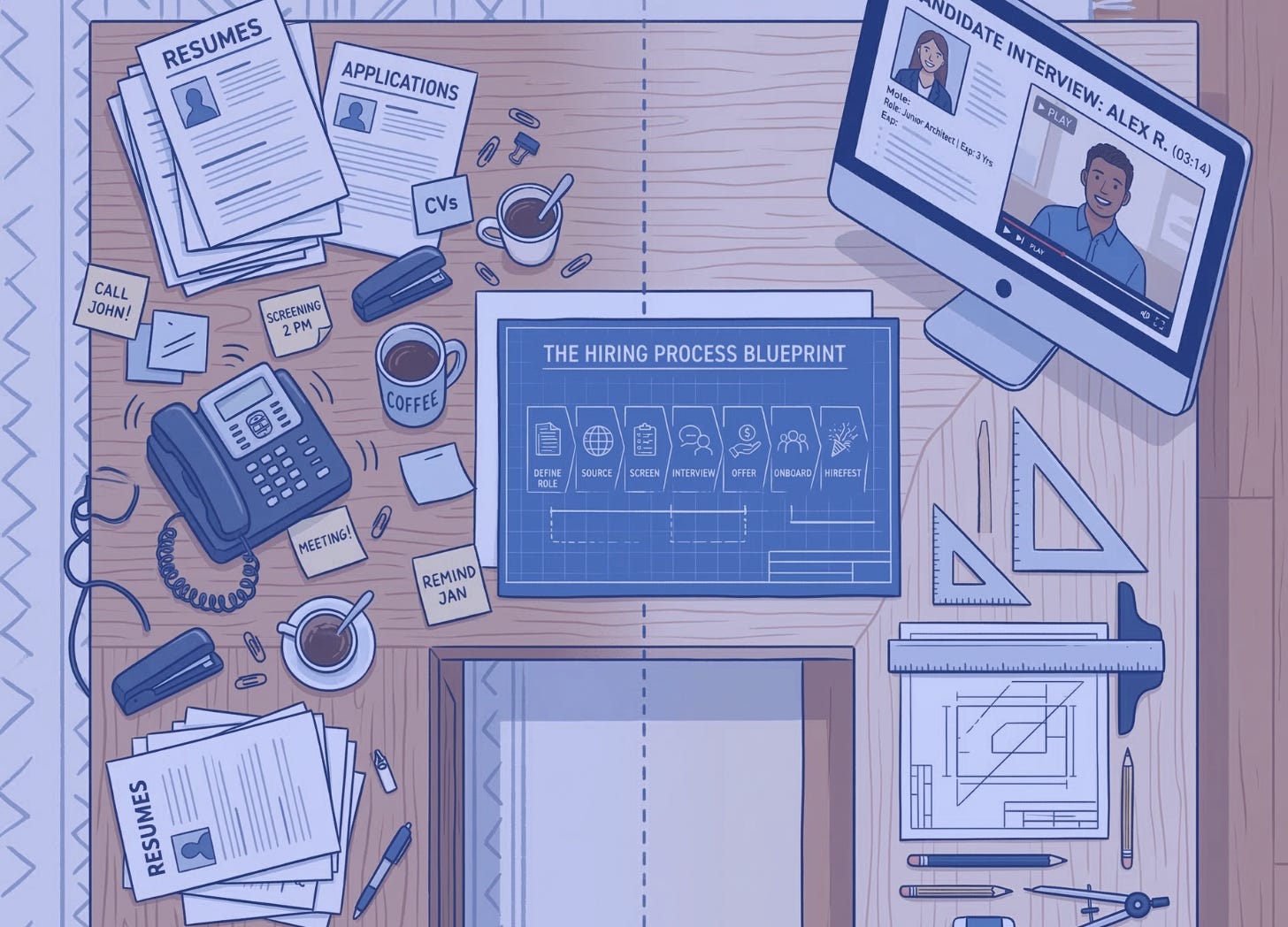
Recruiting used to have a clear value proposition. You were the gatekeeper. You knew the candidates, the hiring managers, the market. You were the person in the room who could look at a resume and a role and say “this one.” The volume was brutal, but at least the job made sense.
That clarity is gone.
Two things killed it. First, the document that the entire process revolves around (the resume) stopped being trustworthy. Candidates are using AI to tailor every bullet point to every job description. Recruiters who’ve been doing this for a decade say they can’t tell the difference anymore between someone who did the work and someone who described it well with the help of a chatbot. The input the whole system depends on is now the least reliable signal in hiring.
Second, AI started doing the parts of the job that used to justify the headcount. Sourcing, scheduling, screening, note-taking, even initial outreach. A senior recruiter I spoke to recently listed every task in her day and marked which ones AI could handle. She ran out of tasks before she ran out of checkmarks. She had no framework for what was left.
These two shifts are colliding at the same time, and the result is a career identity crisis unlike anything recruiting has seen. Experienced recruiters, people with 10 and 15 years in the field, are asking a question they never expected to ask: what am I actually for?
The answer most people give is defensive. They list the things AI can’t do. Relationships. Negotiation. Reading a room. Culture fit. Empathy. And these are real. But listing what a machine can’t do is not the same as defining what you’re for. It’s a rearguard action and not a strategy.
Meanwhile, the day-to-day is getting worse, not better. Recruiters are carrying more open requisitions at a time than ever before. They’re fielding hundreds, sometimes thousands, of applications per role, knowing that half are AI-generated spray-and-pray submissions. They’re running back-to-back interviews all morning, dreading every one, saying the same pitch over and over to people who may or may not be real candidates. Their metrics are tied to time-to-fill, but the hiring manager who controls the timeline won’t return a Slack message for a week.
The recruiters who describe their jobs honestly don’t sound like talent professionals. They sound like traffic controllers in a system nobody designed consciously. One I spoke to called herself a “glorified admin.” Another said his job had turned into “people sales, all I do is pitch and hope.” A 15-year veteran said she’d never hated the work more than she does right now. Not because the work is hard. Because the work doesn’t feel like it matters.
And that’s the real problem. Not AI. Not volume. The problem is that recruiting was built around processing documents instead of understanding people. The ATS is a document management system. Activity KPIs measure document throughput. Resumes are documents. The entire infrastructure assumes that if you move enough paper fast enough, good hires happen. They don’t. They never did. But the system was functional enough to obscure that fact. AI just made the dysfunction impossible to ignore.
Here’s what’s interesting to me: the recruiters who aren’t panicking about AI are doing fundamentally different work. They’re spending their time on intake strategy, getting the hiring manager to articulate what they actually need before a single candidate is sourced. They’re coaching hiring managers, not just serving them. They’re building evaluation frameworks that don’t collapse the moment a polished resume shows up. They’re thinking about process design, not process execution.
These recruiters have a different relationship with their calendar. Where the average recruiter dreads Monday morning because it’s a wall of screens and inbox triage, these people spend their time on the parts of hiring that determine whether the hire succeeds. Judgment. Influence. Decision architecture. The work that AI makes more important, not less.
This has two major implications:
Every recruiter is a Talent Architect. The job is no longer about processing volume. It’s about designing the system that determines how your company hires. That means deciding what AI should own (resume parsing, scheduling, initial signal gathering) and what requires a human (intake alignment and role context, hiring manager calibration, candidate evaluation, closing). The recruiters who thrive won’t be the ones who resist AI or the ones who automate everything. They’ll be the ones who design the system and choose where each piece goes. Architects don’t lay every brick. They draw the blueprint.
Every recruiter needs to stop measuring activity and start measuring outcomes. The current metrics (screens completed, time-to-fill, submittals per week) measure how fast you move documents through a pipeline. They don’t measure whether the hire was right. As long as recruiters are evaluated on throughput, they’ll keep doing throughput work. And throughput work is exactly what AI replaces. The shift to outcome-based work (quality of hire, hiring manager satisfaction, offer acceptance rate, 90-day retention) is not just a nice idea. It’s a survival strategy.
As AI continues to absorb the transactional layer of recruiting, the role is becoming positionless. The old categories (sourcer, screener, coordinator, recruiter) are collapsing into a single question: can you design a hiring process that gets the right person into the role without wasting everyone’s time?
If you’re a recruiter who has looked at your calendar and thought “none of this is what I signed up for,” you already know the current system is failing you. The question isn’t whether the job changes. It’s whether you get to define what it changes into.
This newsletter is about building that definition. And the blueprint to go with it.